Satya Dunning- What becomes possible when we live beyond survival?
WEAll member Satya Dunning shares a deeply personal reflection on what a wellbeing economy can look like in everyday life. Through the story of “Team 76” — an intergenerational and multicultural household in Glasgow — Satya explores how care, trust and mutual support can create forms of security and connection that exist beyond purely transactional relationships.
At a time when many people are experiencing rising living costs, housing insecurity and financial precarity, this blog offers an honest and hopeful perspective on dignity, community and the possibility of organising our lives around interdependence rather than constant economic pressure
I am delighted to share my personal experience of what the wellbeing economy looks like in my daily life for the WEALL blog. Yet, even with this hopeful way of living, I want to be honest about the tensions that remain: the enduring anxiety of “what comes next” in the next 6 months and beyond - can I afford to rent? - and the very real relentless precariousness of financial stability in a very uncertain and unpredictable world.
What becomes possible when your energy is not consumed by the cost of living?
This is the wellbeing economy in practice: a way of living where care, housing and connection are organised around interdependence rather than money.
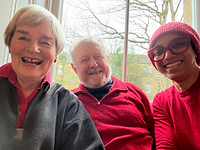
In our Glasgow intergenerational, multicultural, bipedal and quadrupedal household, known as Team 76, we live this reality every day.
Let me do a round of introductions:
The red team from left to right, Alison, Neil and Satya. Dugald the dog, Rahab and Pip.
Our set up envisioned by homeowners Alison and Neil redistributes time and care, reduces loneliness, makes flexible work possible and meets needs outside the market economy. Our approach intersects with the values of dignity and fairness: the hope is that when basic needs are met, self actualisation becomes real and possible. We re orient ourselves away from economic abstraction and become available to community.
In return for a home, Rahab, Pip, Dugald and I bring companionship, connection and support around the house (perhaps not Dugald with the latter). This creates social wealth based on kindness. Like most people, coming from a world where everything has a price, it took me time mentally to adapt. Bringing Neil a cup of tea not because “I should” or “must” but because his comfort is my joy.
For Neil and Alison, this arrangement combats the chronic loneliness that one in ten older people experience. Their lives are enriched by the stimulating conversations, culture and perspectives we bring.
For us, the younger residents, the lifting of financial burden has transformed our lives.
Rahab: a scholarship student from Kenya, can focus on her Masters and save for her son’s future. She has been immersed in Scottish culture: from architecture to the way we sit at the table sharing stories (and the fact that Dugald the dog has his own insurance).
Pip: for him, the connection is spiritual based on trust, not transactional. He values hours spent talking with Neil about history and childhood memories. “It’s not like someone who leaves on the dot because their time is up.”
Satya: having a chronic health condition, I can work part time to suit my capacity. This set up allowed me to repay a debt and launch my freelance creative work from a place of safety instead of survival.
There is a profound privilege to live with people as they age. It provides a unique perspective on respecting boundaries, limitations, wisdom, strengths, and skills. When Alison is away, the three of us step with care for Neil and Dugald. This is built on trust, a currency more stable and meaningful than the pound.
What becomes possible when our energy at 76 is not entirely consumed by the cost of living? A little more love finds a home in our hearts, as do creative work, time for care, dignity in ageing, and a sense of belonging that isn’t attached to a price tag.
Satya Dunning.
Satya Dunning is a freelancer Healing Diets Nutritionist, Edu-Therapist Grief Specialist, Somatic Movement Practitioner and Welcoming Ourselves Home Facilitator at Stepping into Life hoping to find her own affordable place to live by the end of this year. She is a member of the Wellbeing Economy Alliance and looks forward to getting involved in WEALL’s Our Homes Our Economy project.